Book an Appointment
Note: This is an appointment request only Depending on the availability of the consultant, appointment will be confirmed to you through mail/call The appointment requests can be made minimum 48 hrs in advance
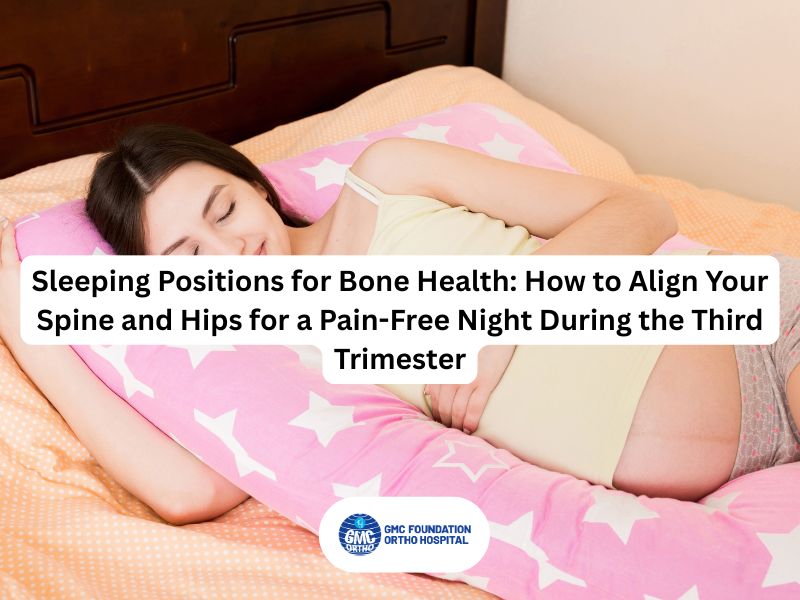
Sleeping Positions for Bone Health: How to Align Your Spine and Hips for a Pain-Free Night During the Third Trimester
April 11, 2026The third trimester of pregnancy is a time of incredible anticipation, but it is also when your body undergoes its most profound physical changes. As your baby grows rapidly, your body’s center of gravity shifts, its weight increases, and a powerful hormone named Relaxin works to loosen your joints and ligaments in preparation for birth. While these changes are essential, they can often lead to sleepless nights filled with hip pain, backache, and generalized musculoskeletal discomfort.
Finding a comfortable sleeping position that doesn't just soothe muscles but aligns your bone structure is critical for your health and rest. At GMC Ortho Hospital Calicut, we recognize that proper skeletal alignment is the key to preventing long-term pain. Here is our comprehensive guide to achieving optimal spine and hip alignment for a peaceful night.
Why Orthopedic Alignment Matters Now
Musculoskeletal pain during the third trimester isn't just about weight; it's about stability. As your pelvic ligaments become more relaxed, your hips can tilt forward (anterior pelvic tilt) and your spine’s natural curve accentuates. When you lie down, gravitational forces can strain these already vulnerable areas if your alignment is incorrect. Poor skeletal alignment can compress nerves, reduce blood flow (the vena cava compression is often discussed for baby’s safety, but it can also affect maternal joint circulation), and lead to morning stiffness.
The Primary Goal: Achieving a Neutral Skeletal Plane
Skeletal structure is designed to distribute weight efficiently. In a neutral plane, your ear, shoulder, hip, and ankle are vertically aligned (if standing) or horizontally parallel (if lying on your side). To achieve a neutral plane when sleeping on your side during the third trimester, you must compensate for the uneven weight of the belly and the widening of the hips. This requires strategy, not just softness.
Top 3 Alignment Positions for the Third Trimester
1. The Super-Supportive Left-Side Position (SOS: Sleep On Side)
While side sleeping—specifically on the left—is recommended by many medical professionals to improve blood flow to the placenta, the standard SOS position is often not supportive enough for bone health. You must actively align the joints.
-
The Problem: Without support, the top leg (the right leg when on your left side) will drop down, pulling the hip and the lower spine into a torque. Your shoulders will collapse forward, causing neck pain.
-
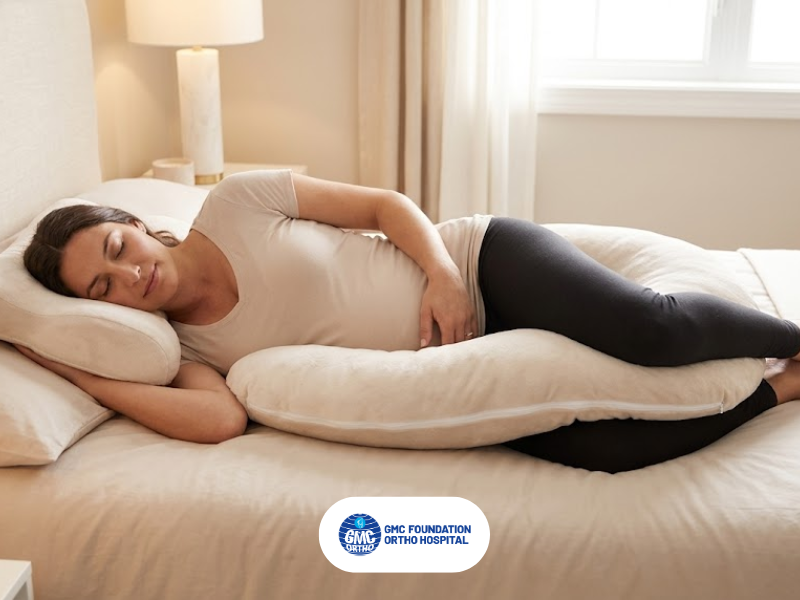
The Optimized Solution: You need a rigid vertical structure to keep your joints stacked. A thick, supportive pillow (or a C-shaped pregnancy pillow) should be placed vertically between your knees and ankles. The pillow must be thick enough to keep your knees the same width apart as your hip joints. (See the included image for a perfect example). This keeps your hips stacked, prevents hip rotation, and keeps your spine in a straight, neutral line. Ensure your top arm is supported by another pillow to keep your shoulders from collapsing forward and straining your upper spine.
2. The Semi-Reclined, "Supported Wedge" Position
For mothers who find pure side sleeping uncomfortable or who experience significant back pain, a supported recline can be highly effective.
-
The Setup: Use supportive foam wedges or a series of pillows (specifically shaped "husband" pillows are great) to prop up your upper body at a gentle 45-degree recline. This recline uses gravity differently, shifting some weight from the hips back onto the sacrum and supportive spine.
-
The Crucial Bone Support: In a reclined position, your spine is in a semi-neutral state, but your knees must still be supported. Place a robust bolster under your knees to maintain a slight bend (this is called a semi-Fowler position). Without this support, gravity will pull the lumbar spine forward, accentuating the lower back curve (lordosis) and causing strain. A thin pillow behind the lumbar curve for slight lumbar support may also be beneficial.
3. The Modified Stomach Sleep (Using Specialized Pillows)
We generally advise against stomach sleeping in the third trimester for obvious comfort reasons. However, if this is your natural preference and you find the SOS position impossible, the introduction of specialized orthopedic pillows can make a modified position safe for bone alignment.
-
The Setup: Use a large bolster under one side of your body (e.g., your left side). You are essentially sleeping against the bolster rather than flat on your stomach. This slightly lifts the pressure off the belly while keeping your spine relatively flat. A pillow must still be placed between the slightly bent knees to keep the hips from torqueing. Ensure your neck is supported but not overly flexed by using a thin, soft pillow.
Beyond the Position: Other Bone Health Essentials
Proper alignment isn't just about pillows; it’s about preparation and equipment.
-
The Role of Physiotherapy: If you are experiencing constant pain, your alignment issues may go beyond simple positioning. Our Physiotherapy and Rehabilitation department at GMC Ortho specializes in prenatal musculoskeletal therapy. Expert therapists can provide targeted exercises to strengthen your stabilising core muscles and pelvic floor, reducing the overall workload on your spine and joints when you are resting.
-
Mattress Firmness: Your mattress must be firm enough to support your skeleton while offering a soft top layer (like a mattress topper) for comfort. A mattress that is too soft will cause you to sink, throwing your spine out of alignment.
-
Pregnancy Support Belts: Wearing a support belt during the day can help stabilize the loose sacroiliac (SI) joints, reducing the strain on ligaments before you even lie down. This makes getting comfortable at night much easier.