Book an Appointment
Note: This is an appointment request only Depending on the availability of the consultant, appointment will be confirmed to you through mail/call The appointment requests can be made minimum 48 hrs in advance
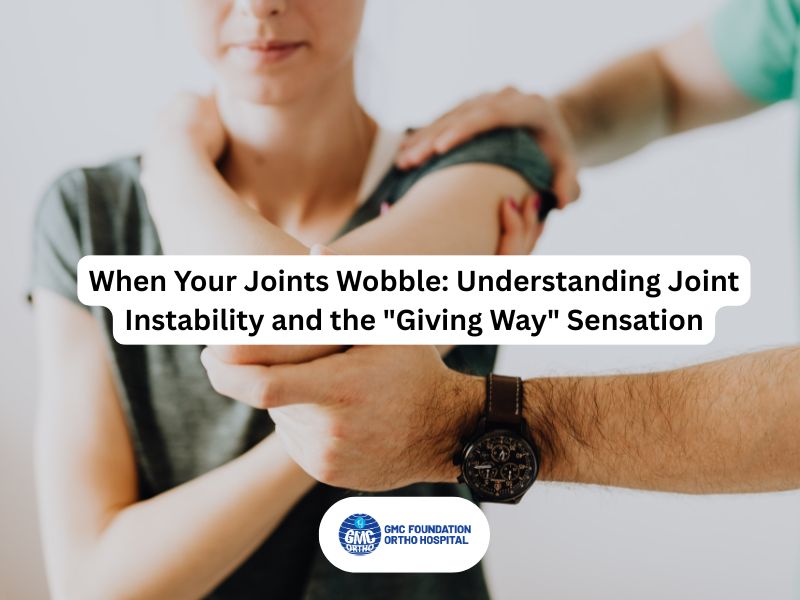
When Your Joints Wobble: Understanding Joint Instability and the "Giving Way" Sensation
May 9, 2026Imagine walking down a familiar path, stepping off a curb, or turning quickly to greet a friend, when suddenly, your knee or ankle feels like it completely blanks out. For a split second, the joint wobbles, shifts out of place, or feels like it is about to buckle entirely under your weight.
This unsettling experience is known medically as joint instability, often described by patients as a "giving way" sensation.
While many people shrug off a momentary wobble as simple clumsiness or a temporary muscle weakness, a joint that cannot reliably support your weight is a major warning sign. It means the intricate internal support system holding your skeleton together has been compromised. Ignoring this sensation can turn a highly treatable soft-tissue injury into severe, long-term joint degeneration.
At GMC Ortho Hospital in East Nadakkave, Kozhikode, our sports medicine and arthroscopy specialists see this symptom daily. Understanding why joints give way and knowing when to seek expert orthopedic care is essential to protecting your long-term mobility.
The Anatomy of a Stable Joint
To understand why a joint becomes unstable, it helps to look at how a healthy joint maintains its balance. Joint stability relies on a complex, overlapping cooperative system between three main components:
-
Ligaments (The Anchors): Ligaments are tough, fibrous bands of tissue that connect bone to bone. They act as the primary structural restraints, preventing your joints from shifting too far forward, backward, or sideways.
-
Muscles and Tendons (The Movers & Stabilizers): Tendons cross the joints to connect muscles to bones. While muscles power your movement, they also provide dynamic stability, contracting rapidly to brace the joint when you change direction.
-
The Nervous System (The Sensor Network): Your joints are packed with specialized nerve endings called proprioceptors. These sensors send split-second signals to your brain, telling it exactly what angle your joint is at and how much pressure it is under, allowing your body to make subconscious micro-adjustments to keep you balanced.
When any part of this three-tier system is stretched, torn, or damaged, the joint loses its mechanical integrity. The result is that unpredictable, frightening sensation of structural failure.
Common Causes Behind the "Giving Way" Sensation
Joint instability can happen anywhere, but it most frequently plagues the heavy weight-bearing joints—the knees and ankles—as well as the highly mobile shoulder joint.
1. Knee Instability: Ligament and Meniscus Tears
The knee is highly susceptible to instability because it relies almost entirely on soft tissues rather than deep bone sockets for its strength.
-
ACL (Anterior Cruciate Ligament) Tears: This is the most notorious cause of a giving-way knee. It frequently happens during sports or sudden twisting movements. When the ACL is torn, the shinbone abnormally slides forward out from under the thighbone, making pivoting or cutting movements feel entirely unstable.
-
Meniscus Tears: The meniscus acts as a shock-absorbing cartilage cushion inside the knee. A torn piece of meniscus can flip out of place and physically get caught within the joint mechanism, causing the knee to suddenly lock up or give way.
-
Patellar Subluxation: This occurs when the kneecap slips out of its natural tracking groove, often causing the leg to buckle immediately.
2. Ankle Instability: Chronic Sprains
If you have sustained a severe ankle sprain in the past and didn't allow it to heal properly, you may develop Chronic Lateral Ankle Instability.
-
The stretched-out ligaments fail to hold the ankle bone securely.
-
Patients often complain that their ankle twists inward easily, even when walking on perfectly flat surfaces or stepping on minor cracks in the pavement.
3. Shoulder Instability: Recurrent Dislocations
Because the shoulder joint is shaped like a golf ball sitting on a tiny tee, it relies heavily on a rim of cartilage called the labrum to stay in place. A traumatic injury or a sports collision can tear this labrum (a Bankart lesion), causing the shoulder to feel loose, slip out of its socket, or repeatedly dislocate during overhead movements.
The Hidden Danger of Delayed Treatment
Many individuals adapt to an unstable joint by subconsciously changing the way they move. They might avoid quick turns, stop playing sports, or wear a rigid elastic brace continuously.
While a brace might offer temporary structural reassurance, it is a double-edged sword. Relying on an external support long-term actually causes the surrounding stabilizing muscles to weaken and atrophy, making the underlying instability progressively worse.
Furthermore, every time an unstable joint shifts or "gives way," the bones grind together abnormally. This unnatural friction shears away the smooth, protective cartilage surfaces. What began as a simple, repairable ligament stretch or tear can rapidly accelerate into premature, painful osteoarthritis, eventually requiring major joint reconstruction or replacement later in life.
Advanced Management at GMC Ortho Hospital
At GMC Ortho Hospital, Kozhikode, we specialize in identifying the structural root of joint instability and deploying tailored treatment protocols to get you back on steady ground.
Precise Diagnosis
Our facility leverages advanced diagnostics to map out soft tissue damage accurately:
-
Dynamic Clinical Testing: Specialized manual stress tests performed by veteran orthopedic surgeons to gauge exactly how much play or laxity is present in the joint.
-
High-Definition MRI: Essential for visualizing the exact grade of a ligament tear, meniscus damage, or labral detachment that standard X-rays cannot see.
Tailored Treatment Options
                     ┌───────────────────────────────┐
                     │ DIAGNOSIS: JOINT INSTABILITY  │
                     └───────────────┬───────────────┘
                                     │
            ┌────────────────────────┴────────────────────────┐
            ▼                                                 ▼
┌───────────────────────┐                         ┌───────────────────────┐
│     PARTIAL TEAR /    │                         │  COMPLETE DISRUPTION  │
│  MILD INSTABILITY     │                         │  / CHRONIC INSTABILITY│
└───────────┬───────────┘                         └───────────┬───────────┘
            │                                                 │
            ▼                                                 ▼
┌───────────────────────┐                         ┌───────────────────────┐
│ • Target Physiotherapy│                         │ • Keyhole Arthroscopy │
│ • Proprioception Care │                         │ • Ligament / Labral   │
│ • Muscle Bracing      │                         │   Reconstruction      │
└───────────────────────┘                         └───────────────────────┘
-
Conservative Rehabilitation: For partial tears or mild instability, our dedicated physical therapy team focuses heavily on neuromuscular and proprioceptive training. By strengthening the dynamic muscle groups surrounding the joint, we can often compensate beautifully for a mildly stretched ligament.
-
Minimally Invasive Keyhole Arthroscopy: If a ligament is completely ruptured (like an ACL) or a labrum is detached, surgical repair is often the best path to regain true stability. Using advanced, minimally invasive arthroscopic techniques through tiny incisions, our surgeons reconstruct the damaged tissue using strong, precise grafts. This keyhole approach minimizes tissue damage, dramatically reduces post-operative pain, and ensures a faster, safer return to an active lifestyle.